A Wave Over the Vatican: JR’s Diluvium
Installation
A seventy-metre wave breaks over the Vatican Apostolic Library: JR blew up a Doré engraving of the Flood to the size of a building. Behind it, AQVA, the library’s show about its oldest fear.
Viacheslav Munister · 2026-11-12
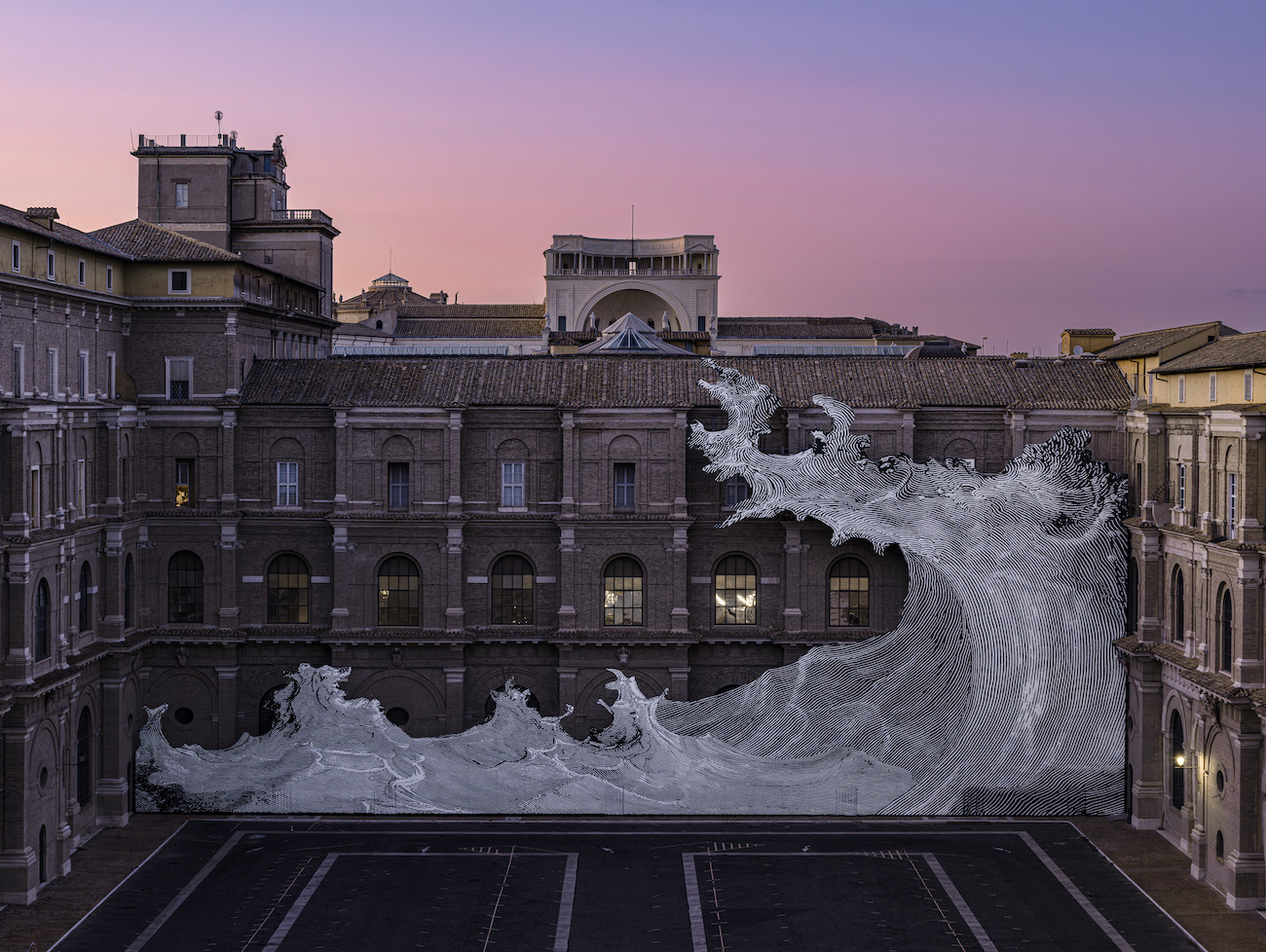
A wave about seventy metres wide is breaking over the Vatican. It rises out of the paving of the Cortile del Belvedere, climbs the Renaissance front of the Vatican Apostolic Library and curls over its windows, black and white, a second before it hits. It is not water. It is Diluvium, a new work by the French artist JR, and it is the first thing you see of a five-year project with which the Pope’s library opens its doors to the public.
An engraving the size of a building
The image is not new. JR took it from Gustave Doré’s illustrations for the Bible, the flood engravings of 1866 that taught generations of readers what the Deluge looked like. It is the method JR is known for: take a picture that already exists, tear it out of its scale and put it where it does not belong. A page that once fitted in two hands now covers a sixteenth-century facade, and the water is caught at the exact instant before it crashes into the stone.
The original is in the show. One of Doré’s engravings hangs inside, so you can walk from the wave in the courtyard to the small print it came from and measure the jump for yourself.
Why a library is afraid of water
The commission came from the library itself. “The library at the Vatican came to see me because, for them, water represents their biggest fear,” JR told designboom. One day the water comes, he said, and takes away all the memory, all the trace of a civilisation that the library has spent centuries keeping.
“For them, water represents their biggest fear.” JR
For the people who work there this is not a metaphor. Water ruins paper, parchment and ink, and the damage cannot be undone. “For a librarian, water is absolute panic,” the vice-prefect, Don Giacomo Cardinali, told ANSA, “because you cannot control it and you cannot stop it.” His answer was to put the fear on the wall. In a time when many people play with fear and use it to steer us, he said, the best thing scholars can do is face their fears and look at them plainly. Fear left alone takes away the taste of life and the beauty of things.
A wave with many messages
JR refuses to keep it about old books. “This wave talks about way more than that,” he says, and lists climate change, extreme heat, political polarisation and “the wave of AI itself”, an intelligence that is swallowing the knowledge stored in books faster than any flood. Water, he told Artribune, holds a duality between catastrophe and resurrection. There are many metaphors held in this wave, he added, about what is happening in the world, things that are sometimes hard to see.
Pope Leo XIV opened the exhibition on 14 September, his 71st birthday and his first visit to the library as pontiff. Speaking in the Sala Leonina, a reading room that Leo XIII made out of an old weapons store, he praised a library that from its humanist beginnings collected not only theology but astronomy, medicine, botany, law and books from every corner of the world, centuries before that openness was common.
Inside AQVA, room by room
The facade is the door to AQVA, the first chapter of Catastrophe and Wonder, a five-year cycle in which the library will face, one by one, the forces that threaten books: water first, then fire, light, insects and finally people. You go in through the wave, staff explain the route, everyone gets an audio guide, and you climb the stairs.
At the top is a room drowned in blue. It remembers Florence, 4 November 1966, when the Arno broke into the National Library and wrecked its halls and stores; sixty years on, a photo album kept at the Vatican shows the scale of the disaster.
Then the tone turns. The next room is full of water as wonder: Apicius’s Roman cookbook, Giovanni Battista Ramusio’s travel accounts, marine bestiaries, coins stamped with rivers and seas. At its centre lies Ippolito Salviani’s treatise on fish, printed in Rome in 1557, page after page of engraved sea creatures, the symbolic heart of the show.
Two living guests answer the old books. The American typographer Bill Moran shows fourteen LetterFish prints, fish built entirely from letters, numbers and printers’ marks; look closely and the scales turn into type. The chef Fulvio Pierangelini adds six short gastronomic stories about water, food and memory.
The last rooms bring the twist the curators promised: water as cure. The library’s own restoration laboratory shows how the same element that destroys parchment is used to save it. And at the very end, in the dark Barberini hall, JR’s second work, Undae, shows another black-and-white wave on a single screen, this time not as a threat but as something to sit with. The water has not changed since the courtyard. Only the way you look at it has.
“These fragile objects hold the world’s thoughts.” JR
See it
Diluvium is on the library front in the Cortile del Belvedere. AQVA runs at the Vatican Apostolic Library until 14 May 2027, curated by Giacomo Cardinali, Simona De Crescenzo, Francesca Giannetto and Delio Proverbio. Visits are by reservation only, through catastrofeemeraviglia.it: regular audio-guided visits in Italian and English on Saturdays, 10:00 to 18:45, and special tours on Fridays at 18:00. Allow about an hour, and take the lift to the fourth floor before you leave: the Sistine Hall of the library, rarely open to the public, is part of the visit.
Facts follow designboom (14 September 2026), Artribune (15 September 2026), ANSA (14 September 2026), My Modern Met (14 October 2026) and Romeing; JR’s Italian remarks are translated from Artribune, Giacomo Cardinali’s from ANSA. Images: designboom (courtesy Vatican Apostolic Library), My Modern Met (photos by Atelier JR) and Romeing (photographers Melvyn Bonnaffé and Olivia Rainaldi), credited under each picture.